


Table of Contents
Introduction
The Reality of Ad Hoc Meetings in Modern Workplace
Why Traditional Conference Rooms Fall Short
How Soundproof Pods Transform Ad Hoc Meeting Culture
Cost Analysis: Conference Rooms vs. Soundproof Pods
Step-by-Step: Implementing Pods for Ad Hoc Meetings
Real-World Applications
FAQ: Soundproof Pods for Ad Hoc Meetings
Conclusion: Supporting Spontaneous Collaboration
Introduction
In today's fast-paced business environment, ad hoc meetings have become the backbone of agile decision-making. Unlike scheduled conferences, these spontaneous discussions happen when they're needed most—a client calls with urgent questions, a team discovers a critical bug, or leadership needs to align on a sudden market shift.
Yet most modern offices are fundamentally unprepared for this reality. Open-plan layouts dominate corporate spaces, offering collaboration but sacrificing privacy. Traditional conference rooms require booking systems that turn "right now" into "maybe tomorrow." The result? Critical conversations happen at desks surrounded by distractions, in hallways lacking professionalism, or not at all.
This is where soundproof office pods emerge as a transformative solution. Unlike fixed conference rooms, acoustic meeting pods provide instant-access private spaces designed specifically for the spontaneous, focused discussions that drive modern business forward.
The Reality of Ad Hoc Meetings in Modern Workplaces
What Makes Ad Hoc Meetings Different
Ad hoc meetings are defined by three core characteristics that traditional spaces struggle to accommodate:
Immediacy: They happen now, not in two hours when Conference Room B is available. A developer finds a security vulnerability at 3 PM—the team needs to discuss it immediately, not schedule a meeting for tomorrow morning.
Unpredictability: You can't plan for spontaneous client calls, unexpected partner visits, or breakthrough ideas that require immediate team input.
Variable Duration: Some ad hoc meetings last five minutes, others stretch to forty-five. Fixed conference room booking systems treat all meetings equally, creating scheduling chaos and wasted resources.
The Open Office Paradox
Modern open offices were designed to encourage collaboration, but they've created an unexpected problem: there's nowhere to have a private conversation. Employees in open-plan offices consistently report that finding quiet space for unexpected calls or discussions ranks among their top workspace frustrations.
The typical response? Walking to an empty corner, using a stairwell, or simply having sensitive conversations at their desk while colleagues try to ignore them. None of these options provide the professionalism, privacy, or acoustic quality that important discussions deserve.
Why Traditional Conference Rooms Fall Short

The Booking System Bottleneck
Conference room booking systems create several problems for spontaneous meetings:
Schedule Fragmentation: A room booked from 2:00-3:00 PM and 3:30-4:30 PM is unavailable for a 2:45 PM ad hoc need, even though it sits empty for 30 minutes.
Booking Overhead: The time spent checking availability, making a reservation, and sending calendar invites can exceed the meeting duration itself for quick discussions.
No-Show Waste: Studies show that 30-40% of booked conference rooms sit empty because plans change, yet they remain unavailable to others who need them.
Size and Cost Mismatch
Conference rooms are typically designed for 6-12 people. When two colleagues need to discuss a project privately, sitting in a large conference room feels wasteful. More critically, building traditional conference rooms requires significant investment—typically $15,000-50,000 including construction labor, HVAC modifications, electrical work, furniture, and permits. The 4-8 week construction timeline disrupts office operations and creates spaces that can never be relocated if your layout changes.
How Soundproof Pods Transform Ad Hoc Meeting Culture
Instant Availability
The fundamental advantage of soundproof meeting pods is simple: they're available when you need them. No booking system, no waiting, no wondering if someone will run over their time slot.
Walk-Up Access: See an available pod, step inside, close the door, and begin your discussion. The entire process takes seconds.
Visual Availability: Unlike conference rooms behind closed doors, pods with glass panels allow at-a-glance availability checking.
Flexible Duration: Use a pod for five minutes or forty-five without pressure to end early or guilt about running over.
Right-Sized Privacy
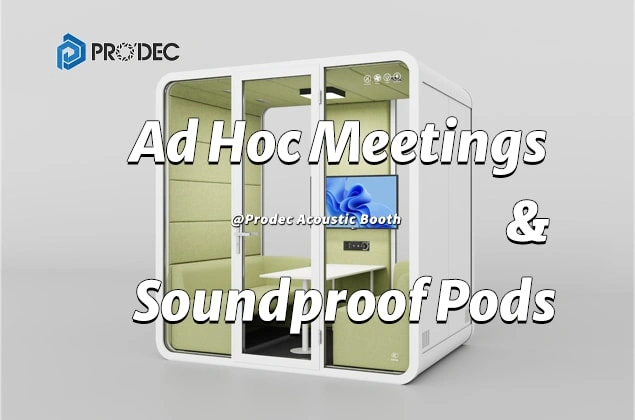
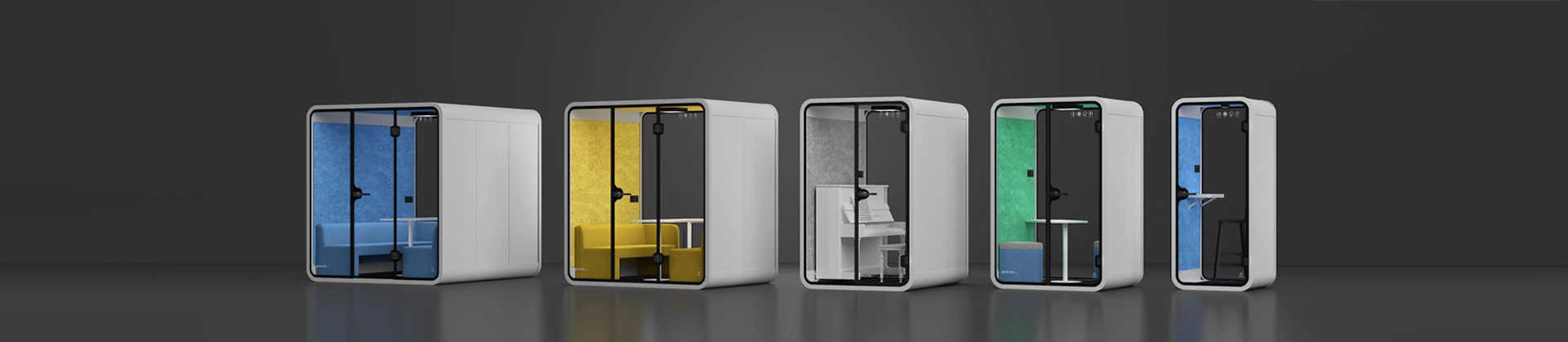
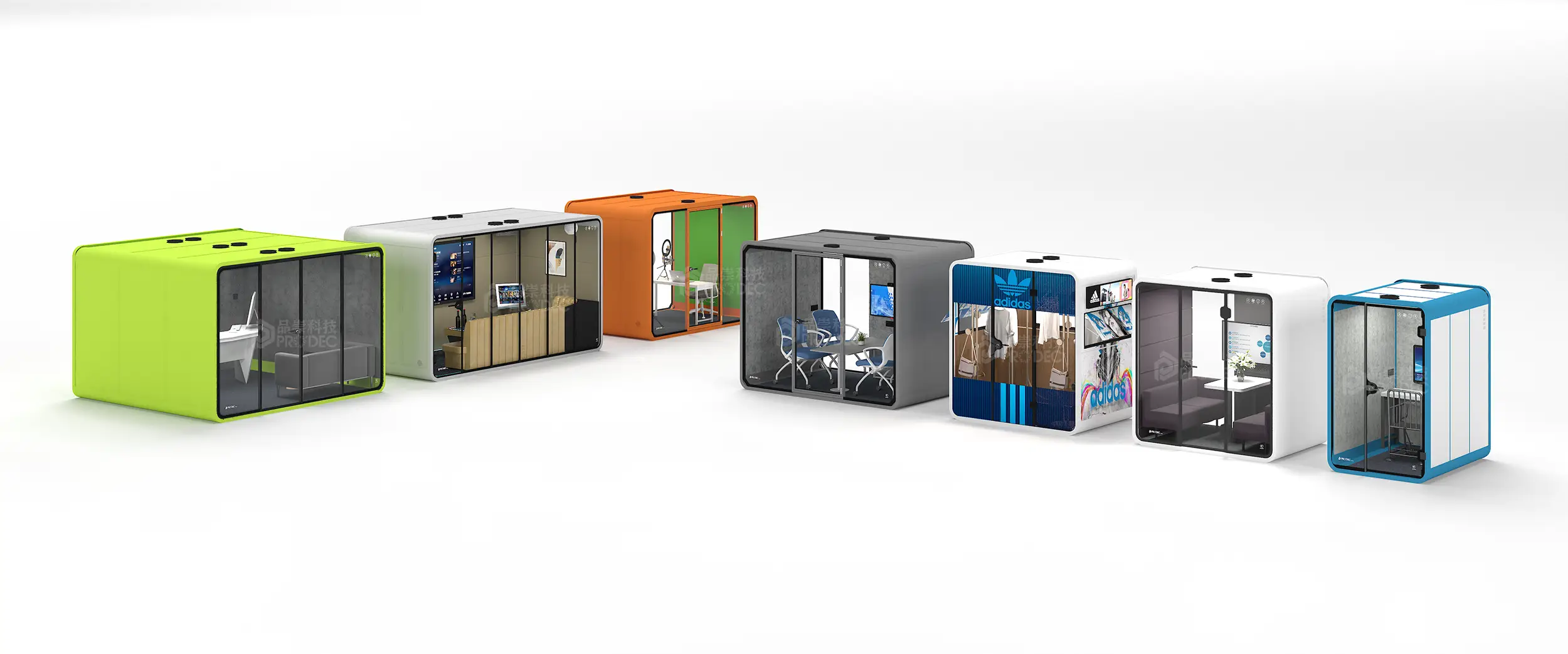
Soundproof pods come in multiple configurations, each designed for specific meeting types:
Single-Person Pods (S): Perfect for urgent phone calls, video interviews, or focused work during office chaos.
Two-Person Pods (M): Ideal for one-on-one feedback sessions, quick project alignments, or confidential HR discussions.
Four-Person Pods (L): Designed for small team discussions, creative brainstorming, or departmental huddles.
Six-Person Pods (XL): Accommodate slightly larger ad hoc gatherings while maintaining instant-access advantages.
Acoustic Excellence
Professional conversation requires professional acoustic conditions. Prodec soundproof office pods deliver this through engineered design:
Sound Insulation: Pods achieve Rw+Ctr 35dB(±5) sound reduction using 38mm double-layer aluminum honeycomb panels with high-density damping insulation material. Conversations inside remain private; noise outside stays outside.
Acoustic Treatment: Interior acoustic materials control reverberation (RT 0.25s ±0.1), ensuring clear speech intelligibility without the echo effect common in hard-walled conference rooms.
External Noise Isolation: Multiple sound barriers in ventilation systems reduce external office noise while maintaining quiet operation.
Complete Technical Integration
Modern soundproof pods are designed as complete workspaces:
Integrated Power: 100-240V outlets and USB charging ports support all devices
Built-In Lighting: 4000K daylight-temperature LED lighting (150LX) provides comfortable illumination
Ventilation Systems: Quiet fans circulate air completely within three minutes
Connectivity Ready: Can be equipped with monitors and video conferencing systems
Cost Analysis: Conference Rooms vs. Soundproof Pods
| Factor | Traditional Conference Room | Soundproof Pod |
|---|---|---|
| Initial Cost | $15,000-50,000 | $1,880-4,400 |
| Installation Time | 4-8 weeks | 3h/pod |
| Construction Required | Yes (permits, HVAC, electrical) | No |
| Office Disruption | Significant (weeks of construction) | Minimal (quick setup) |
| Availability | Requires booking system | Instant walk-up access |
| Flexibility | Fixed location permanently | Relocatable if needed |
| Size Options | Usually one fixed size | 1, 2, 4, 6 person options |
| Setup Time Per Use | 3-5 minutes (tech, room prep) | <30 seconds |
| Acoustic Quality | Varies significantly | Engineered (35dB reduction) |
| Space Efficiency | High sq ft, includes hallways | Compact footprint |
The cost advantage of soundproof pods becomes even more compelling when you consider total implementation. A 4-person traditional conference room costing $25,000+ to build could instead be replaced by multiple pods serving different needs: one 2-person pod for private discussions, one 4-person pod for team meetings—both installed within days for a combined cost of $3,000-5,000.
Step-by-Step: Implementing Pods for Ad Hoc Meetings
Step 1: Assess Your Meeting Patterns
Track how often employees seek private space without finding it, survey teams about workspace frustrations, and monitor conference room booking data for no-shows and over-bookings.
Step 2: Calculate Required Capacity
Small Organizations (20-50 people): Start with 2-3 pods in mixed sizes
Medium Organizations (50-200 people): Plan for one pod per 15-20 employees
Large Organizations (200+ people): Create pod clusters in high-traffic areas
Step 3: Choose the Right Pod Mix
Don't buy all one size. Match pod types to your organization's meeting patterns:
Heavy phone activity: Emphasize S-pods (single person)
Collaborative culture: Focus on M-pods and L-pods (2-4 person)
Client-facing roles: Include XL-pods (6 person) for small client meetings
Step 4: Select Optimal Locations
Position pods near high-traffic areas where people naturally walk. Avoid hidden corners—visibility drives usage. Distribute across floors if your organization spans multiple levels.
Step 5: Establish Simple Usage Guidelines
Suggested duration: 45-minute maximum during peak hours
First-come-first-served: No advance booking
Respect occupancy: Don't knock unless urgent
Clean up: Take belongings when leaving
Step 6: Install and Launch
Professional pods install in 2-4 hours with minimal disruption. No construction, no permits, simple electrical hookup.
Step 7: Monitor and Scale
Track utilization through observation and employee feedback. High utilization (>80%) indicates need for additional pods. Low utilization (<30%) suggests wrong location or size—adjust accordingly.
Real-World Applications
Technology Companies
Software development thrives on rapid communication. Soundproof pods enable immediate pair programming sessions, quick architecture discussions, and incident response coordination. Tech companies report pod utilization rates exceeding 90% during core hours.
Consulting Firms
Consulting success depends on immediate availability when clients need guidance. Pods provide professional spaces for urgent client calls, team strategy sessions before meetings, and confidential project discussions. One consulting firm reduced response time to client inquiries by 40% after installing pods.
Financial Services
Financial institutions face strict privacy requirements. Pods support client portfolio reviews on short notice, compliance discussions requiring confidentiality, and deal negotiations in early stages that require secrecy.
Coworking Spaces
Shared office environments serve multiple companies simultaneously. Pods allow startup founders to take investor calls professionally, freelancers to conduct client calls, and remote workers to handle video conferences with reliable acoustics. Coworking operators report pods are among their most requested amenities.
FAQ: Soundproof Pods for Ad Hoc Meetings
How effective are soundproof pods at blocking sound?
Professional soundproof office pods achieve Rw+Ctr 35dB(±5) sound reduction through 38mm double-layer aluminum honeycomb panels with damping material. In practical terms, a normal conversation inside becomes whisper-level or lower outside, while external office noise is significantly reduced for occupants.
Do soundproof pods need construction or installation?
No construction is required. Pods are modular units that install in hours: position the pod, level using adjustable feet, connect to standard electrical outlet, and test systems. No permits, no drywall, no painting, and no multi-week disruption.
How is ventilation handled in such a small space?
Dedicated ventilation systems with quiet fans provide complete air circulation every three minutes. Multiple sound barriers in airflow tunnels minimize fan noise while preventing stuffiness, even during extended meetings.
What's the real cost of soundproof pods?
Soundproof office pods range from $1,880 for single-person models to $4,400 for six-person configurations, with installation typically included or minimal. This compares to $15,000-50,000 for traditional conference room construction. Pods offer better value when accounting for implementation time, flexibility, and no construction costs.
Can pods be relocated if office layout changes?
Yes, one of the key advantages of modular soundproof pods is relocatability. Unlike constructed conference rooms that are permanent, pods can be repositioned as your office needs evolve, protecting your investment even when layouts change.
How do you prevent pods from feeling claustrophobic?
Professional pod design addresses comfort through glass panels providing visual connection, 4000K LED lighting mimicking natural light, continuous fresh air exchange, and light-colored interior materials. Most users report well-designed pods feel more comfortable than windowless conference rooms.
Supporting Spontaneous Collaboration
The rise of ad hoc meetings reflects how modern organizations operate—with agile, responsive cultures where timely decisions matter more than scheduled planning. Traditional office infrastructure creates friction for this spontaneous collaboration. Conference rooms designed for scheduled meetings don't serve immediate needs. Open offices that encourage interaction lack spaces for focused, private discussions.
Soundproof office pods bridge this gap by providing what ad hoc meetings actually need: instant availability, right-sized privacy, professional acoustics, and technical readiness. At price points ranging from $1,880 to $4,400, they offer significantly better value than traditional conference room construction while installing in hours rather than weeks.
Organizations implementing soundproof pods report measurable improvements: faster decision-making, increased employee satisfaction, better client responsiveness, and more effective use of office space. These benefits translate directly to competitive advantage in environments where responsiveness determines success.
The question isn't whether your organization has ad hoc meetings—it does. The question is whether you're providing the spaces these critical conversations deserve. As workplace flexibility becomes essential, soundproof pods represent infrastructure investment that enables rather than constrains how teams actually work.
Ready to transform how your team handles ad hoc meetings?
Explore Prodec Acoustic Booth solutions or contact us to discuss configurations for your workspace.